This article was originally published in Steel Australia in Summer 2019.
Architects BVN worked closely with BlueScope and Kingspan to create cladding panels made from COLORBOND® Metallic steel with tones and colours befitting of a building that evokes sporting excellence, and captures the Gold Coast’s essence.
Words Leanne Amodeo; Photography Cieran Murphy, Paul Bradshaw (PMB), Peter Taylor, and Paul A. Broben
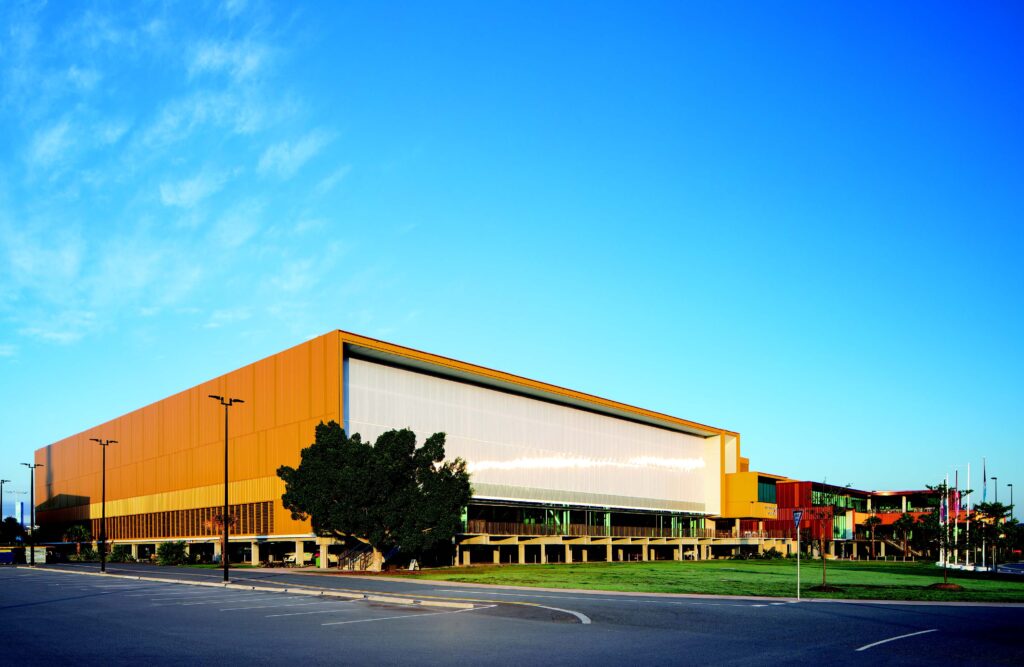
For many people growing up in Australia during the 1980s, the Gold Coast was at the top of their family holiday wish list. Queensland’s second-largest city experienced a tourism boom 30 years ago and the industry is still thriving, fuelled in part by events ranging from the annual V8 Supercars Gold Coast 600, Magic Millions Horse Racing Carnival, Australian Surf Life Saving Championships and Gold Coast Marathon.
The recent biggest event was the 2018 Commonwealth Games, being held in April of that year and the Australian teams did the country proud by topping the medal tally with a swag totalling close to 200, of which 80 were gold. As is the case with any international multi-sport event, the city’s existing sporting venues were revamped and a number of new venues built in the lead-up.
The Gold Coast Sports and Leisure Centre was designed as a new venue for the 2018 Commonwealth Games and still functions as an integral part of a key sporting precinct.
No stranger to the sports and recreation sector, having designed major projects such as the London 2012 Olympic Athletes Village and 2008 Beijing National Tennis Centre, BVN was engaged by its clients in 2013 to develop the masterplan for the precinct surrounding Metricon Stadium – where the Games’ opening ceremony was held – in Carrara.
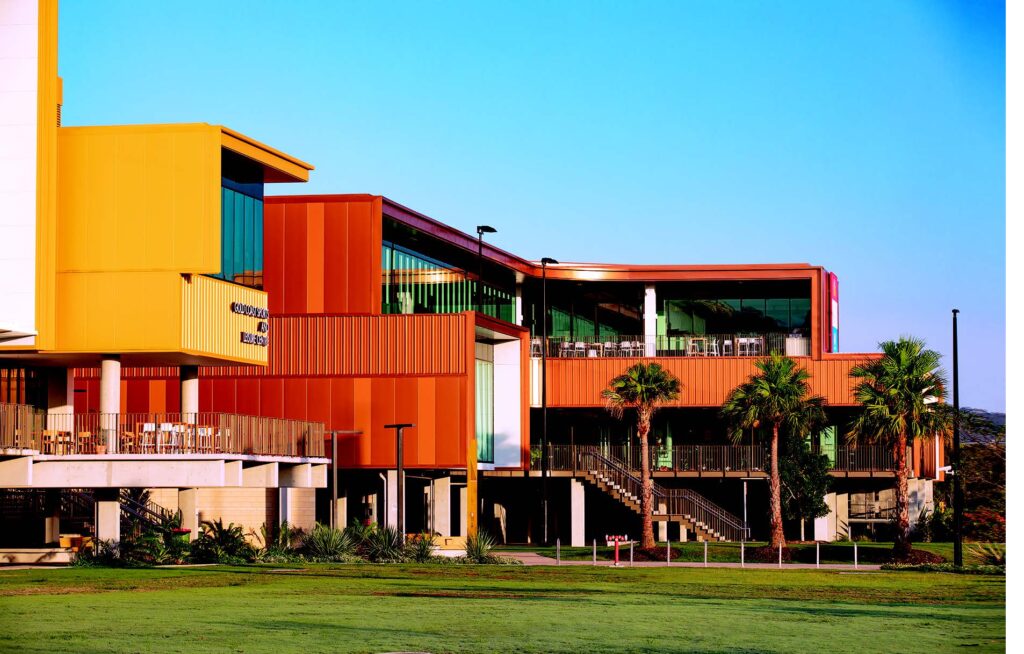
Most significantly, BVN was tasked with delivering the site’s new Gold Coast Sports and Leisure Centre (GCSLC) as the event’s badminton, wrestling and weightlifting venue. The building had to also co-locate the new Gold Coast Suns Elite Training and Administration Facility (GCSETAF), which made good sense seeing as Metricon Stadium is the AFL club’s home ground. Consequently, BVN had a few stakeholders to consider along with three different clients; the Gold Coast 2018 Commonwealth Games Corporation, Gold Coast Suns Football Club and the City of Gold Coast.
Their brief for the new multi-purpose space was therefore not only to provide an international-standard sporting facility specifically for the 2018 Commonwealth Games, but also to ensure the building could be used by the community and other professional sporting groups (particularly netball and basketball) after the Commonwealth Games concluded.
Incidentally, BVN was also responsible for saving the adjacent Carrara Indoor Sports Stadium (CISS) from demolition, convincing the clients that its refurbishment would be of more long-term value to the community than erecting a proposed temporary Games facility.
The GCSLC itself is an ambitiously sized project comprising 26,000m2 across two levels, with a carpark integrated at the building’s ground level contributing an additional 17,000m2 to the internal floor space. BVN’s masterful command of planning is evident in the overall configuration, expressed as a series of simple stacked volumes that belie the facility’s programmatic complexity. This is made more compelling given the initial challenges the site’s constraints posed. So whilst the GCSLC is sandwiched between the existing CISS to the west and Carrara Lake to the east, the architects had to also factor in the procession to Metricon Stadium.
As BVN associate Rebecca Buffington explains, “That’s how we determined the set-back from Nerang-Broadbeach Road because there had to be a connection to the stadium on game days. To enable this we created a new link to the Nerang railway station so people would stream through from the station across the southern plaza in front of the GCSLC, towards Metricon Stadium.” The site is also in a floodplain and BVN responded accordingly by raising the building off the ground. Its orientation was likewise deliberate because everything had to be arranged to sit parallel to the direction of the water, so as not to create any obstacles that could potentially cause a blockage.
A public ‘street’ runs through the centre of the GCSLC and this internal thoroughfare houses change rooms, amenities, event areas, meeting rooms and various food and beverage offerings across two levels. The architects wanted it to feel bright and airy so that the experience of moving through this space was not like being stuck in a tunnel but rather like being in the open outdoors.
To this end, they created organically shaped skylights that look down on the full-height void, like gently glowing jellyfish, and manipulated a portion of the floating mezzanine to curve outwards – essentially forming a viewing platform. A suspended staircase follows this line and bends and turns through the centre of the space in a sympathetically lightweight gesture.
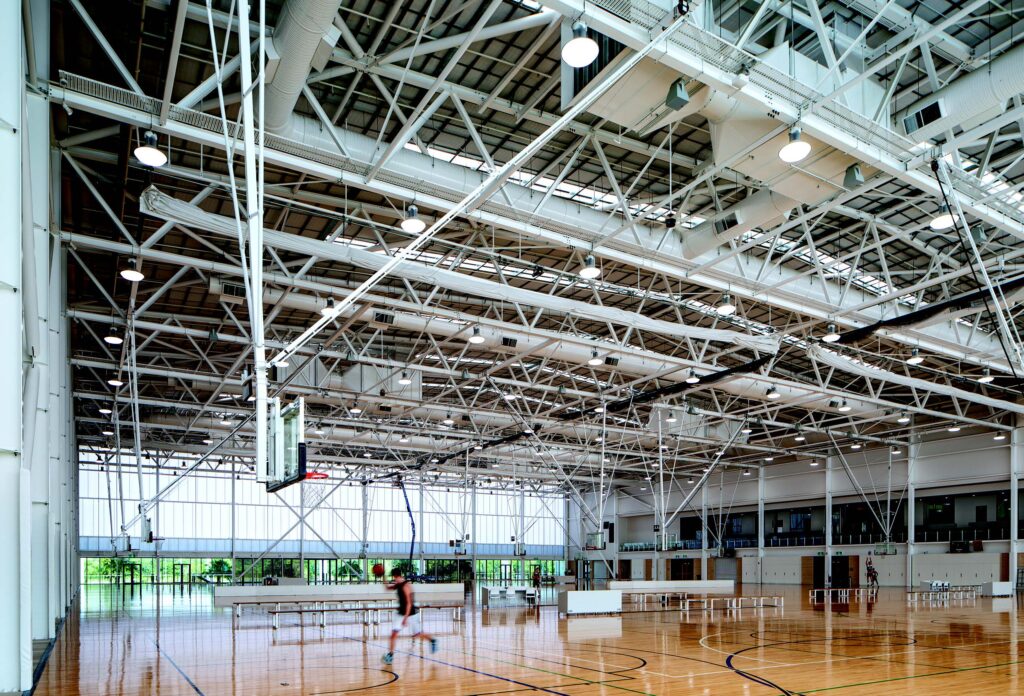
The street is flanked by two multi-purpose halls that boast the flexibility to accommodate a range of sports across 15 basketball courts and a retractable 5,000-seat arena. It also clearly reveals the project’s design inspiration, which is carried throughout the interior spaces and out onto the exterior. “We very much looked to the building’s context for inspiration,” says Buffington. “So we wanted to do something quintessentially Gold Coast and incorporate elements that relate to the climate, are subtropical in appearance and are colourful, vibrant and fun.”
All the interior spaces receive plenty of sunlight, are naturally ventilated and maintain a strong connection to the outdoors via generously sized windows, terraces and verandas. However, it’s the GCSLC’s colour palette that undeniably embeds it within its lush setting and speaks to the Gold Coast’s image as a confident, laid-back city appreciated as much for its lively culture as for its natural environment. The architects incorporated green and taupe accents on the street’s upper level walls as a reference to the hinterlands beyond the southern plaza. And a tile mosaic on the mezzanine floor’s 2,400mm band twinkles with flecks of yellow and gold in a sun-and-sand homage.
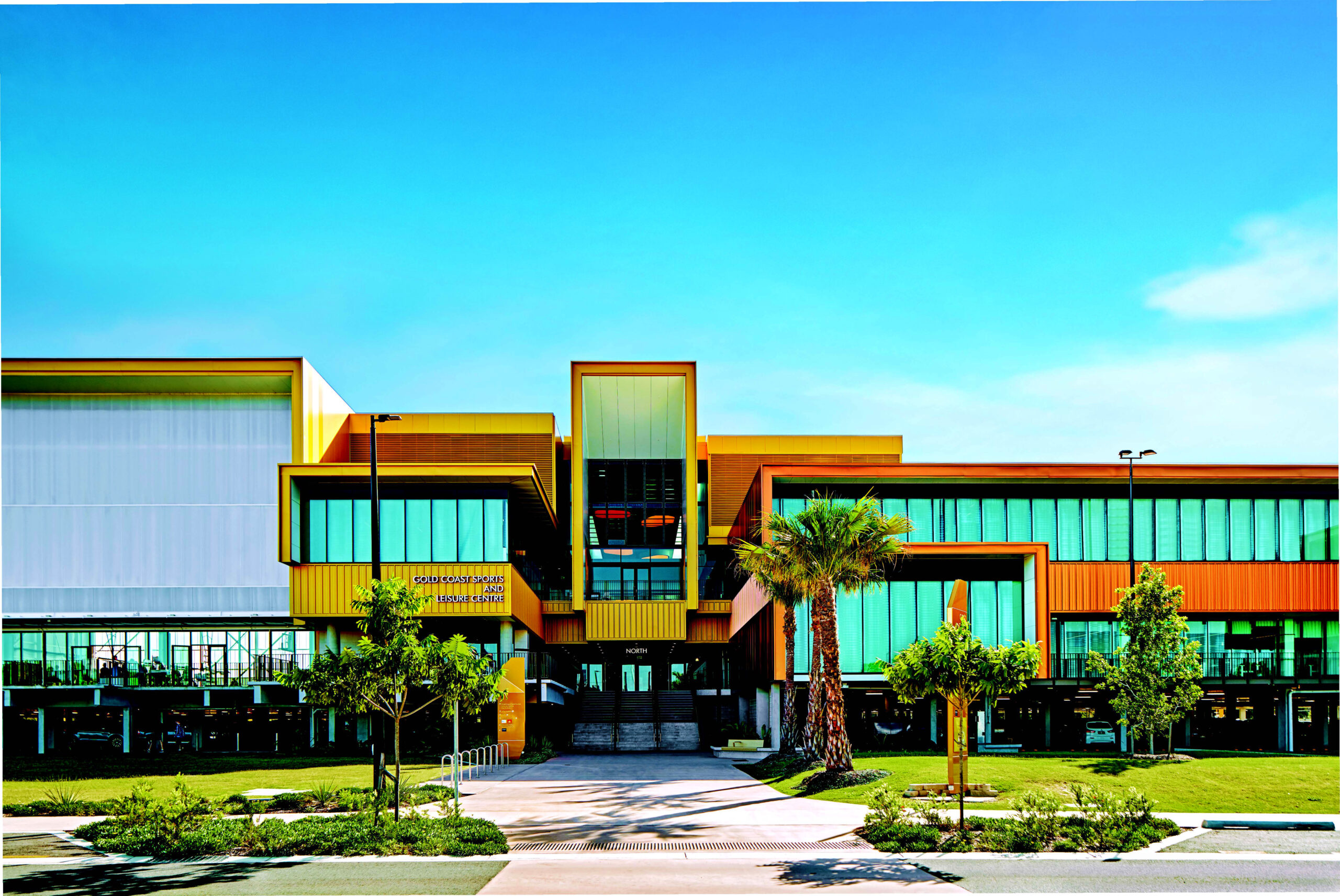
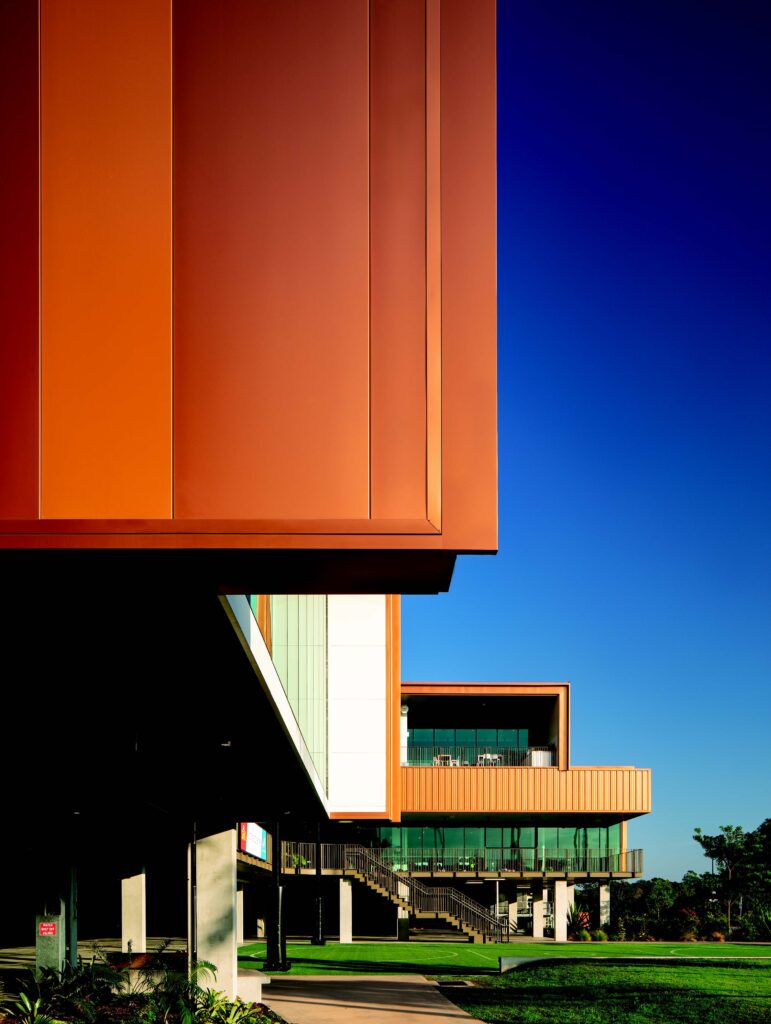
This luminous scheme continues through to the GCSLC’s external wall cladding, comprising two types of Kingspan insulated wall panels: the flat panel BENCHMARK Evolution and also KS1000RW Trapezoidal-profiled panel. These panels are comprised of an insulation core, finished on both sides with steel cladding. In this project’s case, the exterior cladding is predominantly made from COLORBOND® Metallic steel in the custom colours Carrara Gold™ and Temple Gold®, as well as Copernicus® and Copper Penny®.
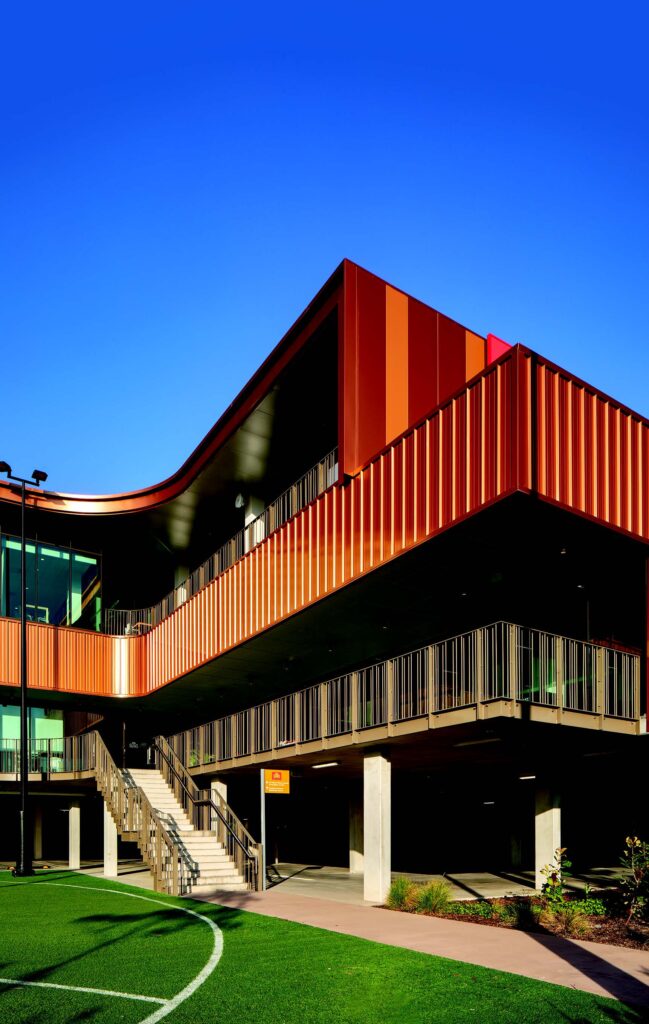
A mixture of 600mm, 900mm and 1000mm vertically laid Kingspan BENCHMARK Evolution modules were specified in all four colours to help visually break down the building’s immense scale. A ribbon datum of KS1000 RW Trapezoidalprofiled panels running around the entire building serves a similar purpose. Quite deliberately, this feature with its distinct panel profile stands at the same height as the street’s mosaic band, cohesively unifying interior and exterior.
The GCSETAF, which sits at the building’s northern end, is also clad in different-sized Kingspan BENCHMARK Evolution insulated wall panels made from COLORBOND® Metallic steel in the custom colours Copernicus® and Copper Penny®. It makes this northern elevation particularly striking, ensuring it has its own identity and acts as the building’s gateway, yet ties in tonally with the GCSLC.
For Buffington, the appeal in using Kingspan panels is that they have a refined simplicity that complements the project’s minimalist materiality. It is also not lost that it’s a practical, low-maintenance product. “We selected the Kingspan wall panel because it can produce an external and internal finish as well as insulation, all in the one system. We didn’t have to do an extra build-up and because we were able to work with BlueScope’s Specification Team and Kingspan to customise COLORBOND® Metallic steel colours, we didn’t have to think about sourcing extra cladding or worry about painting finishes.”
BENCHMARK commercial director, Roof and Wall Panels, Kingspan Insulated Panels, Niall Horgan, says his specification team was heavily involved with the project, from the early sketch design phase through to on-site installation.
“We worked closely with the architect BVN in relation to product selection, available finishes through BlueScope, detailing, thermal performance and fire compliance,” says Horgan. “We also worked closely with the builder, Hansen Yuncken, on ensuring the structural steel frame was suitably designed for our product and that the program was met.”

The building’s predominant colour – Carrara Gold™ – is symbolically linked to first place in high-level sports competitions. It was designed for this project by BlueScope’s paint laboratory technicians and supplied to the architects’ exact specifications.
A beautiful photo of a Gold Coast sunrise was used to select a specific shade. After going through 16 different shades, one was settled on and BlueScope created a Carrara Gold™ sample.
The buildings’ roof is made from 80 tonnes of COLORBOND® Coolmax® steel, only available in the colour Whitehaven®. It may not be visible from ground level, but this cladding is working hard to help reduce internal temperatures on hot days – which is of added importance in the halls during training sessions and games.
COLORBOND® Coolmax® steel in the colour Whitehaven® is an ideal material for large commercial roofs as it is scientifically designed to provide high solar-reflectance and thermal emittance. Highly solar-reflective cool roofing material such as COLORBOND® Coolmax® steel can help lower active cooling energy costs and reduce the urban heat island effect by minimising heat absorption.*
To aid in passively cooling these areas, the architects have ensured they open out to a number of veranda spaces and in this regard, the halls differ to many other sporting facilities because they are so light and breezy.
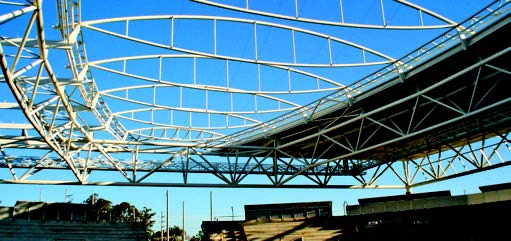
All-in-all, 180 tonnes of purlins and girts made from GALVASPAN® steel and supplied by Metroll, plus 213 tonnes of XLERPLATE® steel was used to help efficiently achieve the project outcome. Case-in-point being the sealed truss system that includes a complex truss joint at the peak of the roof where 16 different steel members come together in that one location. The use of cladding made from COLORBOND® Metallic steel in the custom colour Carrara Gold™ at this venue couldn’t have been more fitting for the Commonwealth Games and well after the event has finished, it still stands iconic.
Whilst the building’s colour palette may appear a smidgen ostentatious, it’s tempered by a thoughtful plan, fine detailing and highly resolved spatiality. This is a venue of which the Gold Coast is very proud and whilst it was originally designed to be a multi-purpose facility, its obvious popularity has even surpassed the architects’ expectations.
*Any savings and or the extent to which a building is cooler may vary and depend upon the particular circumstances of your building, including building location, level of insulation, location of airconditioning when installed, building shape, building function and environmental factors.
For more information about potential savings visit www.steel.com.au/coolmaxcalculator
For more information on urban heat island effect visit www.epa.gov/heatisland/about/index.htm
Project team
- Client: Gold Coast 2018 Commonwealth Games
- Corporation, Gold Coast Suns Football Club, and City of
- Gold Coast
- Architect: BVN
- Builder: Hansen Yuncken
- Structural Engineer: Bligh Tanner
- Steel Fabricator: Steel Fabrications Australia
- Cladding Contractor: Padstar
- Landscape Architects: Cardno
- Steel Manufacturer: BlueScope