This article was originally published in Steel Australia in September 2015.
Queensland State Velodrome, Brisbane
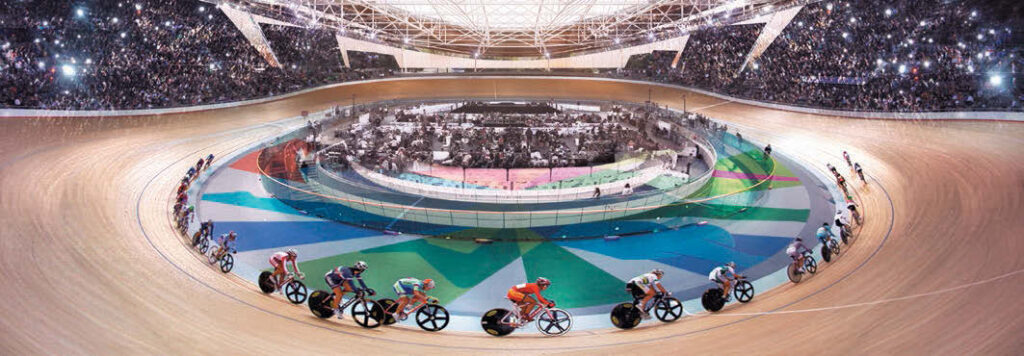
A lightweight steel frame is enabling one of the broadest clear spanning roof structures in Australia to be installed over an international standard cycling track and associated facilities for the new Queensland State Velodrome to be ready to host track cycling competition for the Gold Coast 2018 Commonwealth Games.
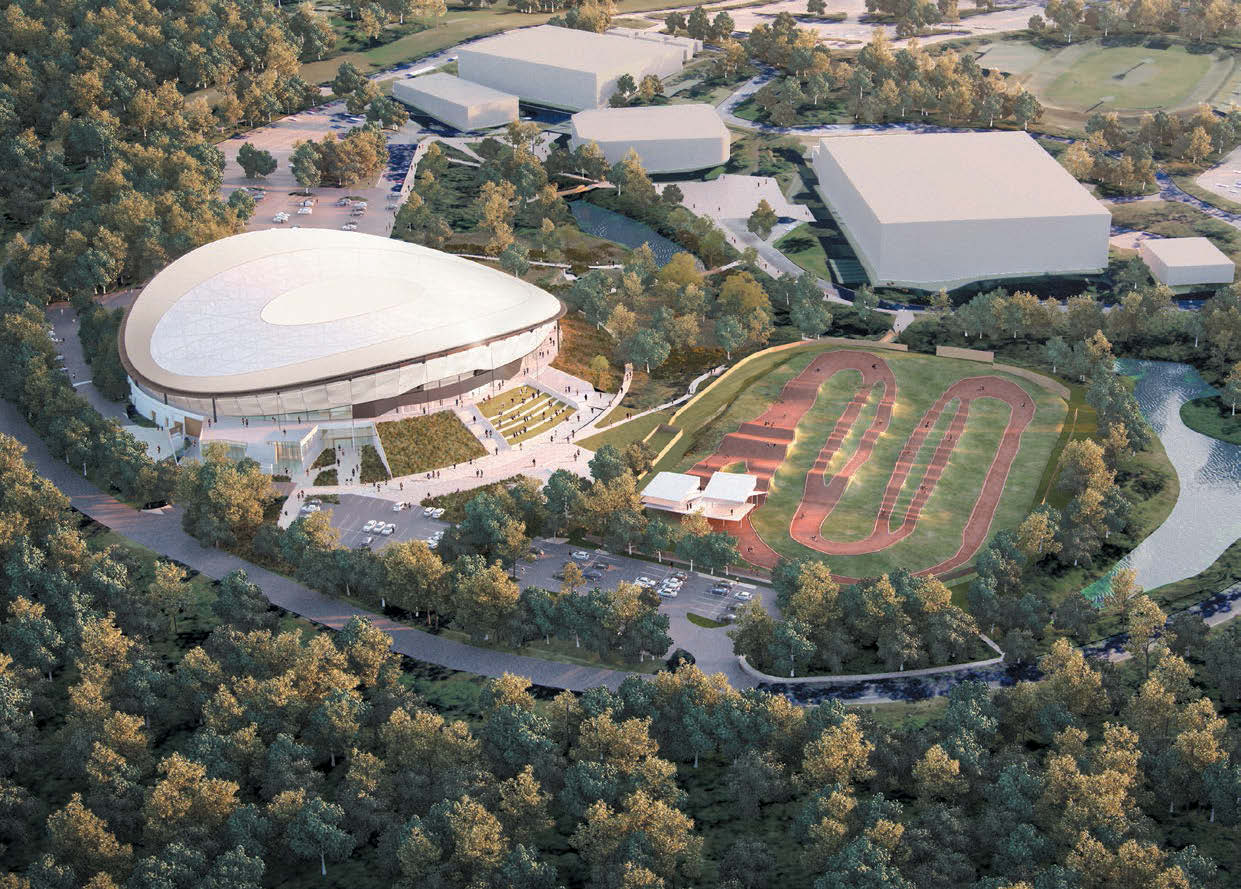
Jointly funded by the Queensland Government and Australian Government and scheduled to be completed in mid-2016, the facility is being located alongside the Brisbane Super X BMX Track at Sleeman Sports Complex as Queensland’s first indoor velodrome. It will provide 1500 permanent seats with provision for expansion to 4000 with the addition of temporary seating.
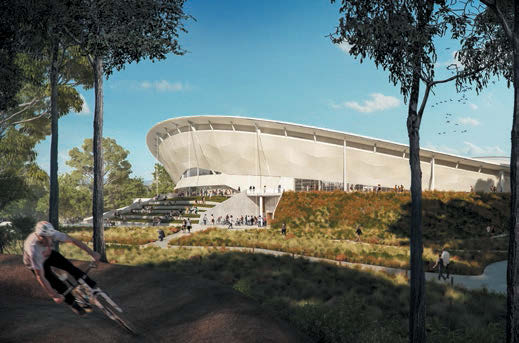
Principal of project structural engineer Arup, Ian Ainsworth said the basic architectural concept by Cox Rayner that underpins the design is “a bowl that grows from the undulating landscape with a sweeping roof form”.
“The ‘dish’ form is achieved through a synergy between the use of a hyperbolic parabola for the roof form, the angle of its supporting columns and the form and material of the façade cladding,” he said.
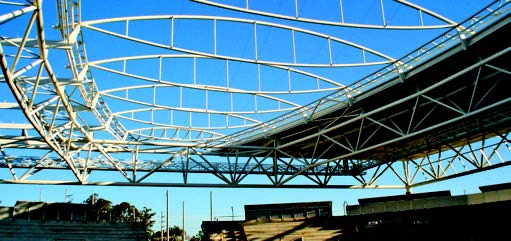
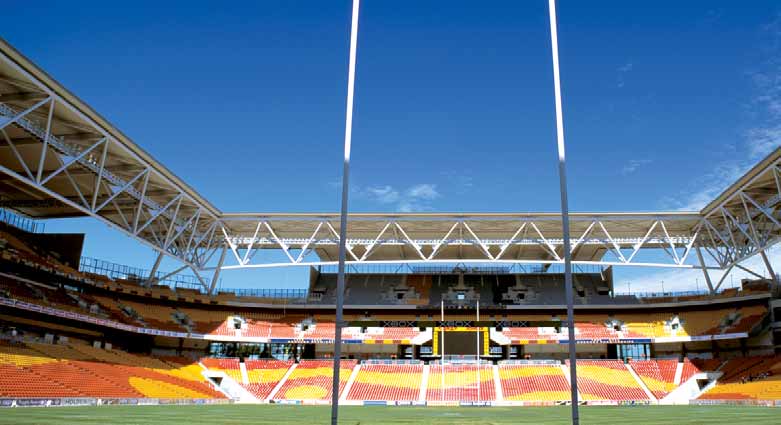
Structural engineer at Arup, Mitchell Mulvey said the saddle-shaped roof structure spanning 118 metres in one direction and 115 metres in the other consists of lightweight steel planar trusses radiating from a central truss ring referred to as the ‘oculus’. The outer edge of the roof is supported by inclined circular columns corresponding with the radial grid as well as vertical ties or props adjacent to each inclined column.
“The use of steel framing for the long span roof offers structural efficiency and minimum weight,” Mr Mulvey said. “Through the use of planar radial trusses that can be readily prefabricated and erected without the need for temporary propping over the annular track and grandstand areas, the steel framed roof can be rapidly and safely erected in parallel with the complex concrete substructure, saving time.”
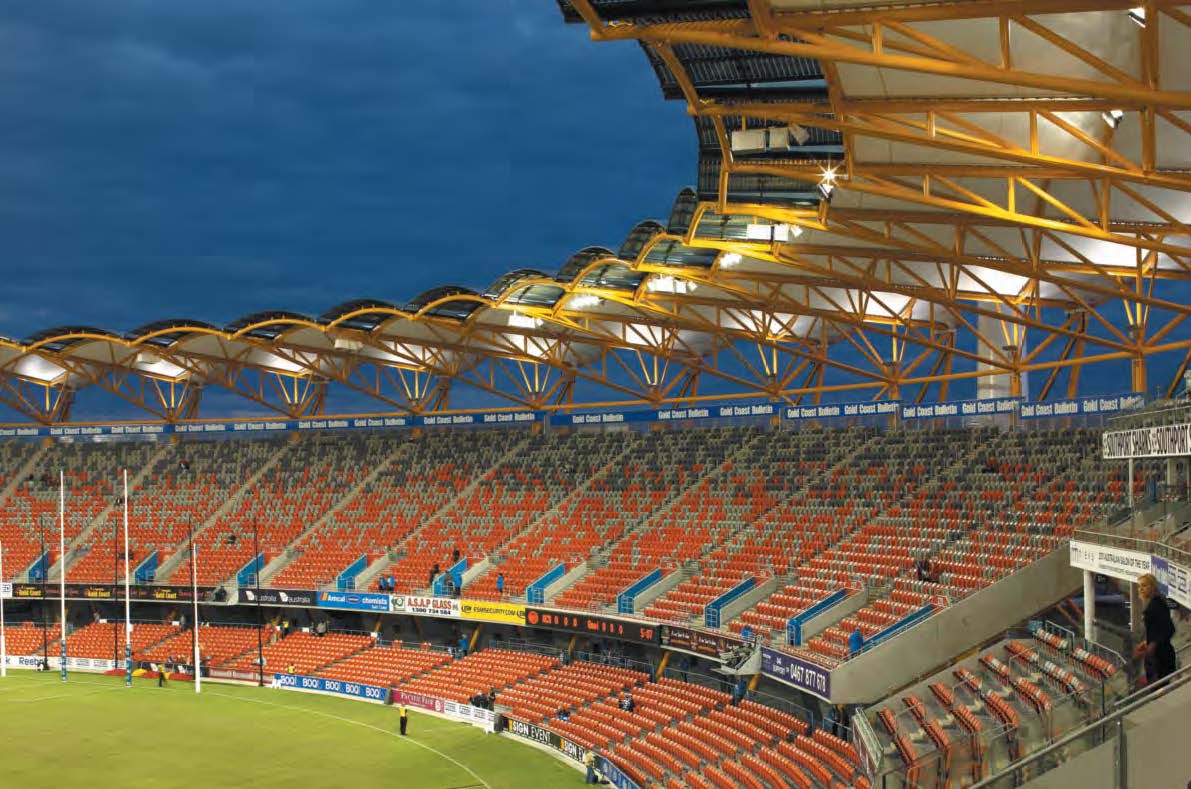
He said that Arup has drawn from its considerable experience with major Queensland sports facilities such as Suncorp Stadium and Metricon Stadium combined with specific velodrome experience from Hong Kong, Rio de Janeiro and the UK.
The geometry and framing of the roof was developed by investigating over a dozen different structural schemes, ranging from one-way orthogonal trusses to 3D space truss solutions and cable nets.
Advanced analytical techniques and parametric modelling were then used to investigate various options for the steel roof including radial tied trusses, grid shells and cable nets and then to optimise the selected design, balancing steel weight and construction and fabrication efficiency.
He said the Arup team also took advantage of the shell action available from the doubly curved nature of the saddle-shaped roof and the partially buried nature of the building to reduce steel weight by designing the main north-south trusses to act as arches, thrusting against large concrete abutments anchored into the hillside.
“In addition, the visible lower chords of radial trusses and roof bracing elements that sail through the upper part of the roof consist of either slender CHS members or rods, resulting in a remarkably light and airy feel to the space,” he said.
The end product is a very efficient structure with a primary roof steel weight of less than 50 kg/sqm.
One of the key architectural features is the raking façade which is formed by raking columns coupled with a vertical one.
“In the east-west direction, the roof acts as a catenary and the vertical elements are in tension and therefore can be relatively thin cables,” he said.
“As you slowly move around the structure in the north-south direction, the roof acts as a dome and hence the elements are in compression. As you move around the structure, you see this change in topology or evolution where the thin elements gradually get larger for some dynamic architecture.”
He said that Arup worked very closely with the architect Cox Rayner in the early design phases allowing close coordination of the architectural and structural components and helping to minimise issues later on in the design.
Once the building contractor and steel tender was awarded, he said they held weekly design meetings to minimise rework and to iron out any issues.
“This has proved beneficial for the primary steelwork with few changes being required,” he said.
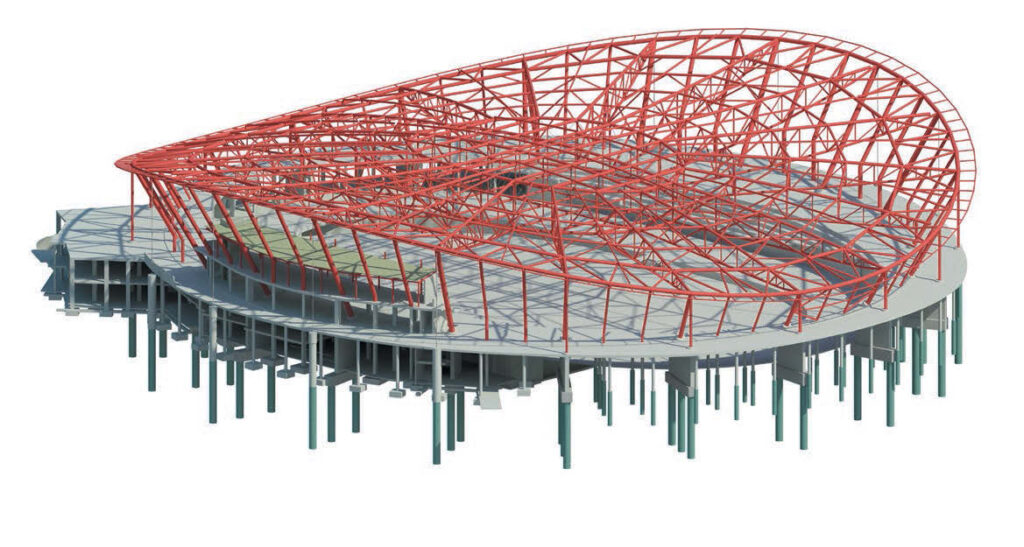
Mark Finney, the Director of the project’s steel fabricator and ASI member, Beenleigh Steel Fabrications said the Velodrome permanent roof structure, temporary works, secondary wall and roof framing and internal roofs and awnings require a total of 900 tonnes of hollow sections and 300 tonnes of plate.
Having previous involvement with the builder Watpac on many stadiums in Queensland, Beenleigh has drawn on that experience to avoid issues that are common in stadia construction.
“Construction of stadiums needs to be carefully planned and coordinated to avoid building yourself out of an area as they are large structures,” he said.
“Large assemblies were prefabricated in our workshop and welded together onsite utilising cradle connections that satisfied the structural and visual requirements for the project.
“Eaves, gutter and louvre framing has also been panelised to provide a clearer alternative to the more traditional stick-build method.”
He said careful planning was required in conjunction with Beenleigh’s temporary works engineer Rob Thiess of Construc to determine the safest and most efficient construction sequence utilising temporary towers to support the central ‘oculus’ structure which remain in place until the outer roof structure and supporting columns have been installed.
“The structure is then de-propped allowing it to deflect some 175-200mm into its final alignment in conjunction with the tensioning of the 75 ø VSL CT stress bars,” Finney said.
Beenleigh’s investment in new energy-efficient inverter welding plant proved timely on this welding intensive project that provided substantial energy savings.
“Most of the welded tube joints in the structure are stiffened with plates welded into the joints to the extent that there is approximately 80 tonnes of Grade 350 plate embedded inside CHS framing,” he said.
“The design of the structure is such that the majority of the structural steel framework is a visible feature in the finished product so a very high quality, architectural finish is required to the steelwork coupled with stringent structural requirements.
“As all of the visible steelwork is coated in a high quality polysiloxane paint system, the structural connections needed to be aesthetically shaped and all steelwork was dressed to a marine grade finish.”
Watpac and their client, Stadiums Queensland has strict quality requirements that have been addressed within Beenleigh’s QA system compliant with ISO 9001: 2008. These quality requirements are further enhanced by independent testing and inspection.
Project team
- Client: Queensland Department of State Development
- Architect: Cox Rayner Architects
- Structural Engineer: Arup
- Builder: Watpac
- ASI Steel Fabricator: Beenleigh Steel Fabrications
- Construction and Temporary Works Engineer: Construc
- Steel Detailer: Online Drafting Services
- Surface Treatment: Tranzblast
- Coatings Supplier: PPG Industries
- ASI Steel Distributor: BlueScope Distribution
- ASI Steel Manufacturer: BlueScope (plate)