This article was originally published in Steel Australia in June 2016.
Coomera Indoor Sports Centre, Queensland
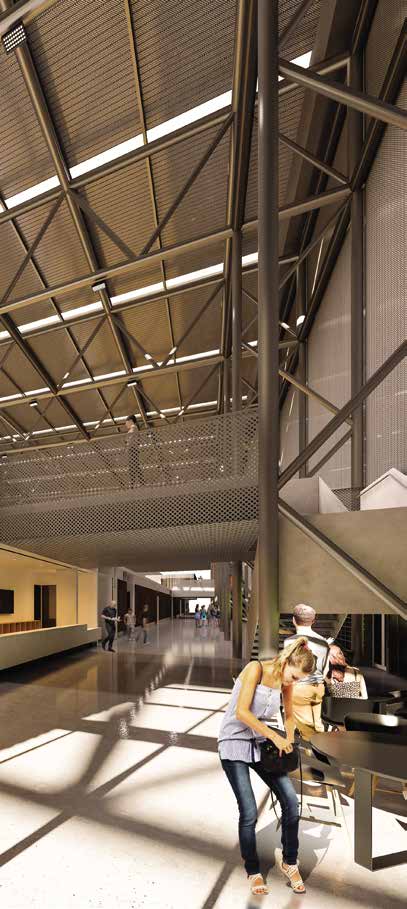
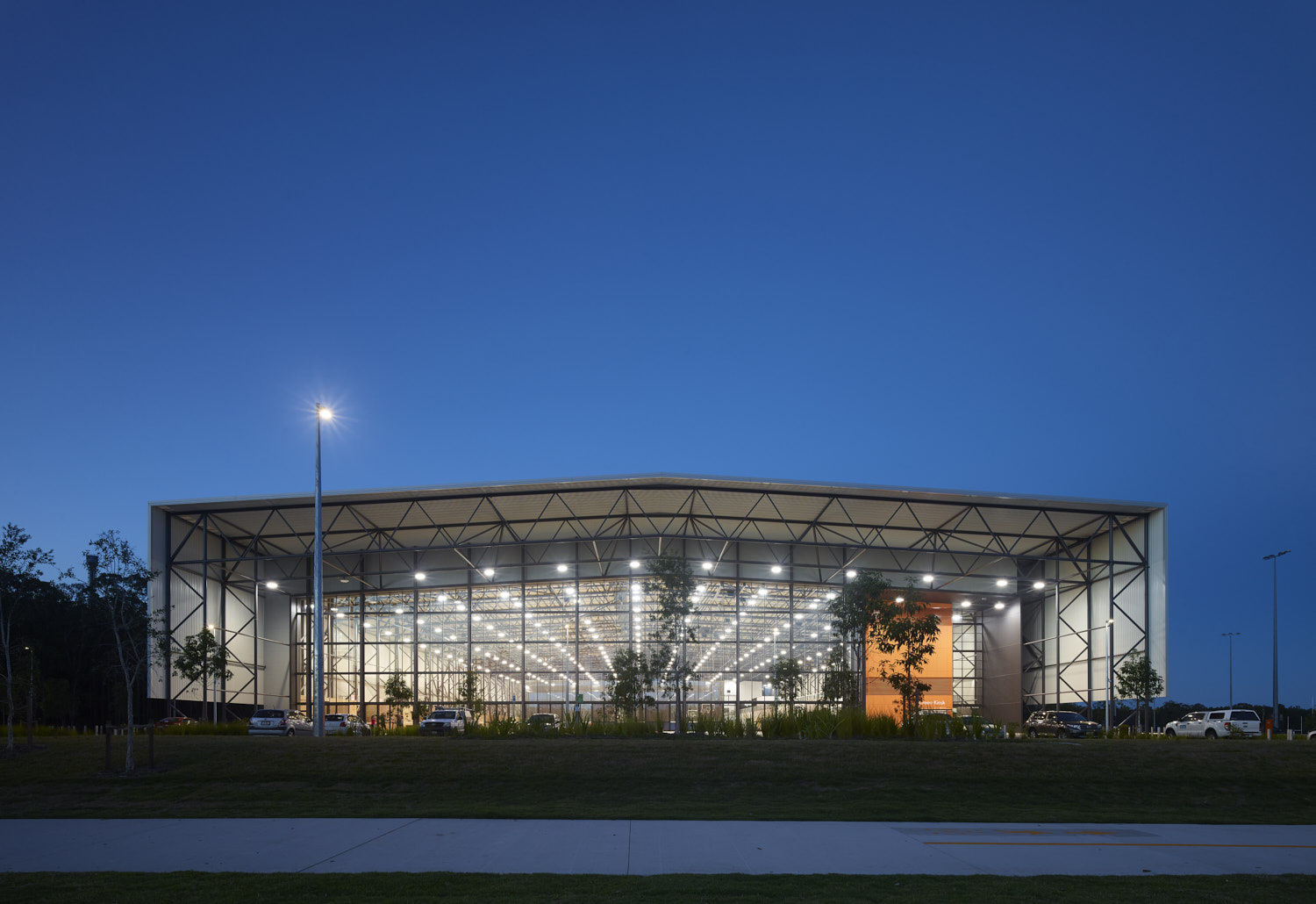
The ability to construct long free spans with steelwork has proven critical for this new multi-purpose indoor facility at Coomera that is required to host high profile sporting events with space flexibility and accommodate a range of athletic activities simultaneously under one roof.
Located on Queensland’s Gold Coast, the venue has been designed to world-class competition standards with potential for elite training and competition use and community sports such as netball, volleyball, basketball and gymnastics.
Scheduled for completion in late 2016, the venue will be more than ready to host the Gymnastics competition and Netball finals for the Gold Coast 2018 Commonwealth Games.
The project was designed by Gold Coast architectural practice BDA Architecture in association with Peddle Thorpe Architects (Melbourne). BDA Director, Peter Devonport said steel played a very important part in meeting the project’s design brief which called for “clear, flexible and adaptable spaces which will comfortably adapt for the Games mode operation, and provide flexibility of operation”.
“The brief was to provide a space for basketball, netball and gymnastics which required a large volumetric space and steel was determined to be the best solution to do this,” Mr Devonport said.
“We drew the project in Archicad to provide a model for all consultants to coordinate during the design development phase. This provided understanding of the structure and more importantly the construction method and detail of the steel structure.”
Gold Coast-based Structural Project Manager at Arcadis, Richard Needs said that the main challenge for the engineering team was to achieve the large span and clearance to underside of the roof structure required by the regulatory authorities for each of the sports that will use the facility.
“This was also a requirement to accommodate the temporary grandstands used in the Commonwealth Games mode and was achieved by using deep welded steel parallel flanged trusses for both the columns and the rafters,” he said.
“A number of options were considered during the schematic and developed design stages which included propped portal frame, arched rafter and other variations.
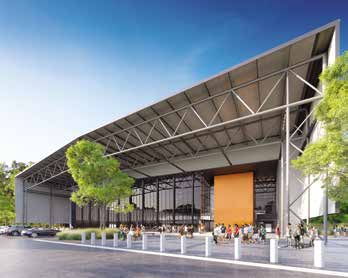
“However, the open truss solution maximised the space and provides clear sight lines for spectators for both the Commonwealth Games mode and the legacy post-Games mode.”
He said that once their open truss solution was proposed and agreed with all stakeholders, the focus then was to minimise the structure to encourage a slimline look while maintaining the serviceability requirements of the structure.
“During the schematic and developed design phases, our design team looked at many types of structure as reference points including other sporting facilities, aircraft hangars and large-span retail projects,” Mr Needs said.
“With this historic knowledge we were able to come up with concepts that were developed into the streamlined large span frames used.”
He said that construction efficiency and sustainability were also key considerations for this high profile public facility.
“Early in the process, we decided to develop the structural Building Information Model (BIM) using AutoCAD Revit to a level of detail that would minimise the number of requests for information (RFIs) during the fabrication,” he said.
“To that end, the majority of connections were modelled in 3D to ensure that the spatial and strength requirements were met. This decision was validated in that we received less than 10 RFIs from the fabricator which is significantly less than would normally be expected for a project of this size.”
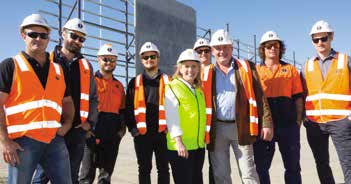
The project’s steel contractor, Alltype Welding (ATW) Group was able to carry out the entire steel package in-house encompassing fabrication, surface blasting and coatings as well as rigging and installation via cranes onsite.
ATW Group HSEQ Advisor, Mitchell Horne said the project mainly comprises tubular sections (UBs, channels, line and light pipe) and is the longest open span structure it has completed. He said that operating a local facility was a key factor that helped win the fabrication contract.
“The project totals 670 tonnes of steelwork including structural frame, stairs, roof and cladding and we were able to fabricate everything offsite at our Staplyton facility,” he said.
“Night deliveries were important due to the size of the truss sections so we had to get special permits and have police to help escort the deliveries to site, but we found this project very easy to erect as we had a big open area onsite to conclude our works.
“We purchased a 2010 LTM 10-90-4.1 Liebherr mobile crane for the erection of this project to work alongside our 70 tonne crawler crane.”
He said that non-destructive ultrasonic testing (NDT) was required on 10 percent of all full strength butt welds and blasting and painting testing and records were carried out to ensure compliance to requisite surface preparation standards.
Project team
- Architect: BDA Architecture and Peddle Thorpe Architects (Melbourne)
- Contractor: Hansen Yuncken
- Structural Engineering: Arcadis
- Coatings Supplier: International Paint
- ASI Steel Fabricator: Alltype Welding Group
- ASI Steel Distributors: OneSteel Steel and Tube (main structure), Lysaght (purlins)
- ASI Steel Manufacturers: BlueScope, OneSteel