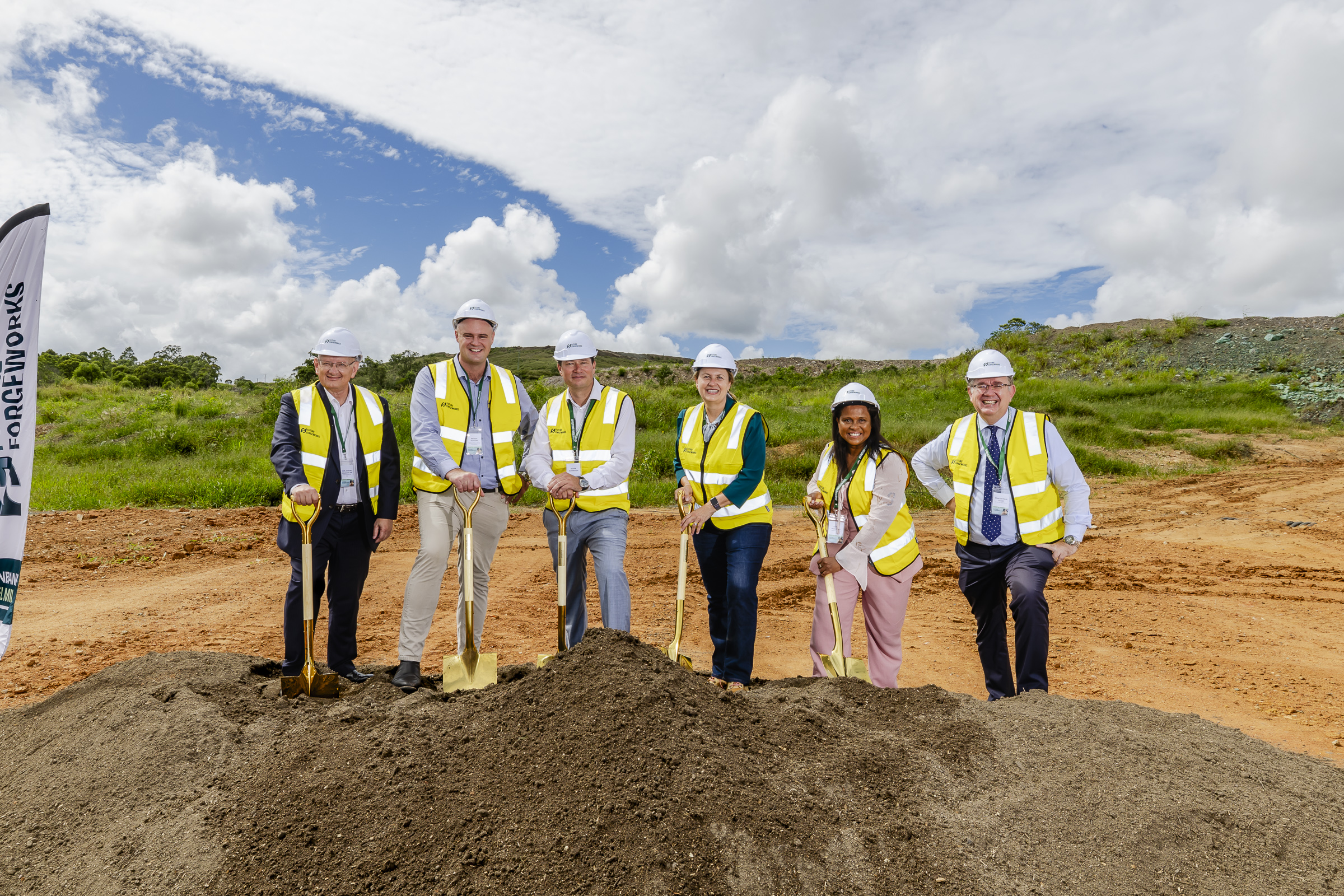
In south-east Queensland’s industrial corridor, ASI associate member Future Forgeworks is preparing to do something Australia has not seen in three decades: build a new steel mill from the ground up.
According to managing director Rohan Richardson, “Future Forgeworks’ Swanbank Steel Mill is planning to be one of Australia’s first new steel mills in 30 years and Queensland’s first circular economy-focused steel facility.”
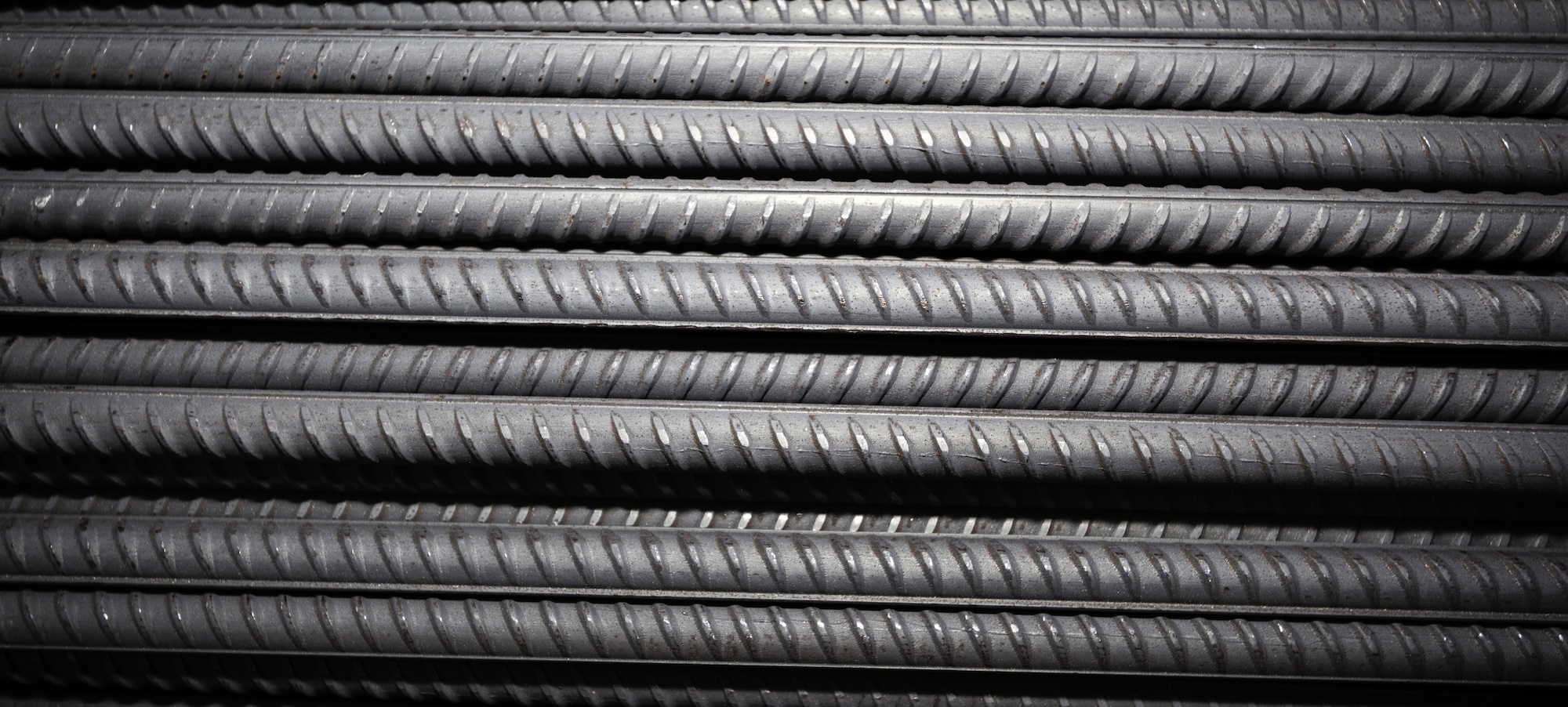
Designed to produce low-emissions reinforcing bar and coil, the Swanbank Steel Mill brings together electric arc furnace steelmaking, continuous mill technology and a circular economy model built around Queensland scrap metal and Queensland energy.
For Richardson, the project is both a professional evolution and a personal undertaking.
“After dedicating 23 years to leading large-scale facilities and capital-intensive projects across the Australian and international energy sector, I wanted to take on my own project in a purpose-driven company focused on driving a transformative leap in Queensland’s heavy industry,” Richardson says.
The idea emerged while Richardson was undertaking a business school program and exploring opportunities with long-term industrial impact. Steel, and in particular reinforcing bar, stood out because of the convergence of construction demand, supply chain resilience and decarbonisation.
“I saw an opportunity for a steel mill in Queensland that could leverage the circular economy and produce rebar at an exciting time for Queensland where the scale of infrastructure and investment is unprecedented,” he says.
Queensland is heading into a decade of major infrastructure delivery: Brisbane 2032, hospitals, housing, energy projects, defence work and the broader pipeline of public and private construction. Future Forgeworks expects first steel in early 2028, as demand for Australian-standard reinforcing products continues to intensify.
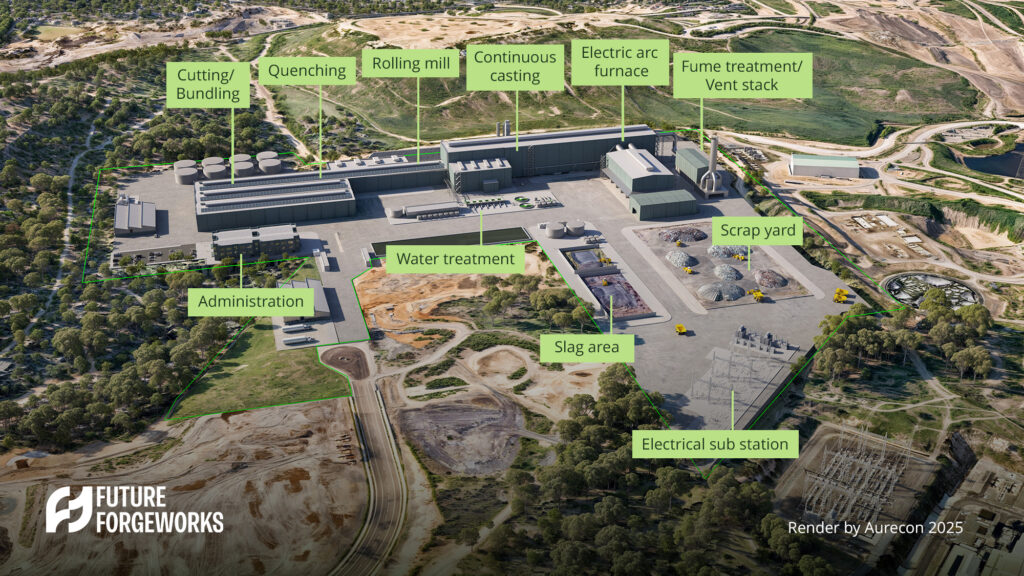
The Swanbank steel mill
The Swanbank facility has been designed around SMS group’s CMT350® continuous mill technology, with an annual production capacity of 350,000 tonnes of reinforcing bar and coil from approximately 385,000 tonnes of locally sourced scrap metal.
“We’re excited to bring the SMS group’s continuous mill technology to Australia which has significant advancements over the current production methods,” Richardson says. “I have no doubt it will deliver the greenest, safest, most efficient production route for steel making in Australia.”
In practical terms, the continuous production route removes billet reheating from the process, reducing energy consumption and production time while improving yield. The mill also incorporates advanced quenching technology, automation, safety and emissions controls.
The environmental case rests on more than technology. Future Forgeworks is focused on locality, shortening the distance between scrap supply, production, fabrication and construction markets. “We expect to source Queensland scrap metal, and Queensland energy to supply the local Queensland construction infrastructure market,” Richardson says. “This results in significantly less transport costs, lower emissions, less processing time and a quality product for the Queensland economy. We are excited to be introducing a circular-driven business model to Queensland.”
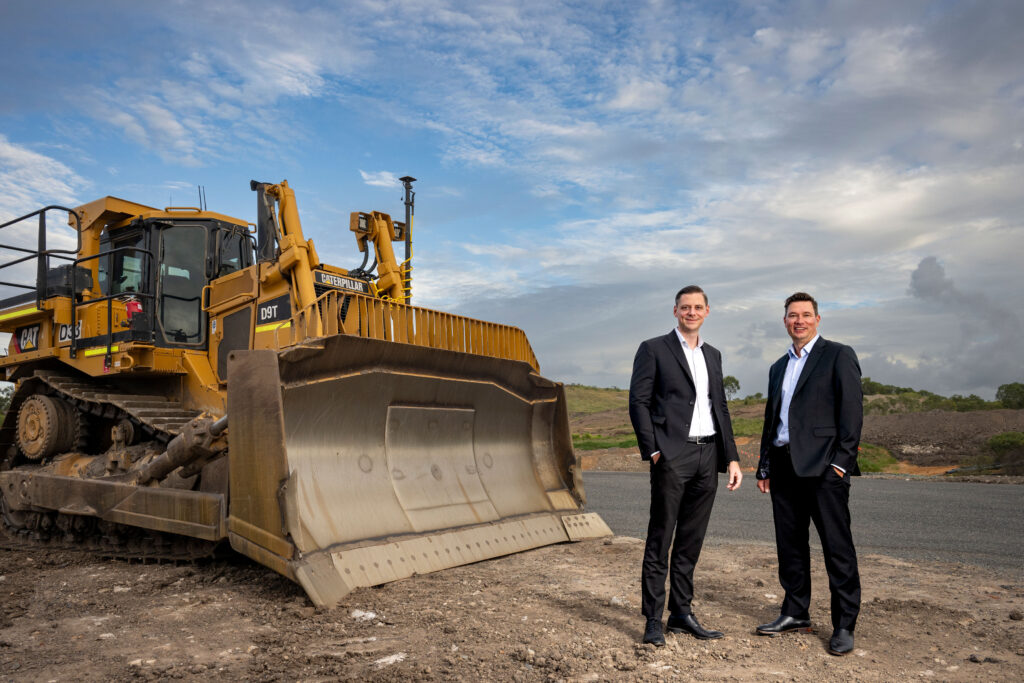
Supporting the local region
For construction clients, the Future Forgeworks model is designed to offer lower-emissions reinforcing bar without sacrificing quality, reliability or cost competitiveness. For the region, it is intended to keep more economic value within South-East Queensland. Future Forgeworks has committed to a local economic injection of up to $100 million, more than 400 construction jobs, 200 permanent site-based positions and more than 500 jobs across the supply chain over the life of the facility.
“I’m very proud to be part of the Australian steelmaking journey,” Richardson says. “The foundations have been laid by generations of successful steel makers and steel continues to play a critical role in Australia’s economic strength and sovereign capability.”
Richardson sees the Swanbank mill as a continuation of that history, rather than a departure from it. “Our project looks to build on this story with modern practices enabling a step change in national steel making capability,” he says.
That step change has required careful technical and community groundwork. Future Forgeworks received development and operational approvals through Ipswich City Council and the Queensland Government, following feasibility work and technical assessments spanning noise, air quality, traffic, water and safety. Its community materials outline environmental controls including an enclosed melt shop, fume treatment plant and closed-loop water recycling.
Richardson says community and stakeholder response has been strong. “It has been very positive so far,” he says, noting his own connection to Ipswich, where he spent part of his childhood and early school years. “There has been an overwhelming level of positivity, particularly from the Ipswich council and community.”
Ipswich has a long manufacturing history, and Future Forgeworks believes that the Swanbank project could be an opportunity to position the region as a centre for advanced manufacturing.
Between now and 2032, Future Forgeworks estimates the mill could replace approximately $2 billion in imports with cost-competitive, low-emissions rebar. Richardson says that volume is “enough rebar to build around 72 Olympic-sized stadiums or 315,000 houses.”
“To be part of delivering one of Australia’s first steel mill project in 30 years is a massive draw card for me,” Richardson says. “We’re also very excited that, once operational, we may become a partner of choice for Queensland fabricators, distributors, scrap providers and also an employer of choice for the 200-odd future vacancies that we’re looking to recruit.”
Richardson is clear-eyed about the scale of the task, but optimistic about the foundations already laid.
“We’ve had a high level of support from the industry segments, from the government and the community,” he says. “While this is a large, challenging project, with all the support we’ve received and continued to receive, it’ll be a sure-fire result.”
This article was supplied as part of a paid advertising package.