In steel yards, fabrication facilities and distribution centres, long-load handling is part of the daily rhythm of work. Pipe, tube, plate, beams and other long products are moved, stored, picked and dispatched every day, often in busy environments where mobile plant, pedestrians, trucks and loading zones all intersect.
It might be routine work, but it is not necessarily simple work.
According to Baumann Sideloaders Australia Managing Director Craig Armstrong-Fray, one of the most important safety questions for the steel industry is whether businesses are using equipment designed for the way long loads actually behave.
“Long-load handling brings a very specific set of risks,” Armstrong-Fray says. “In many cases, businesses have relied on equipment that works well for general materials handling, but long steel behaves differently. The key is understanding those differences and selecting equipment that supports the load, improves visibility and helps operators manage the task safely.”
Conventional forklifts are versatile machines, but when it comes to long steel products, they can introduce challenges that are not always easy to control through operator skill alone. Long products can be difficult to stabilise, difficult to see around and difficult to manoeuvre safely through doorways, aisles and congested yards.
“One of the central issues is support, says Armstrong-Fray. “Long loads do not behave like pallets. A bundle of pipe, tube or bar can move, flex, bounce or wobble when it is not adequately supported across its length.”
“When it comes to long loads, the load needs to be supported across more than just the centre,” he says. “When something big and long is carried by a forklift, there is not a lot to stop it wobbling. With tube and pipe, our goal is to eliminate that wobble.”
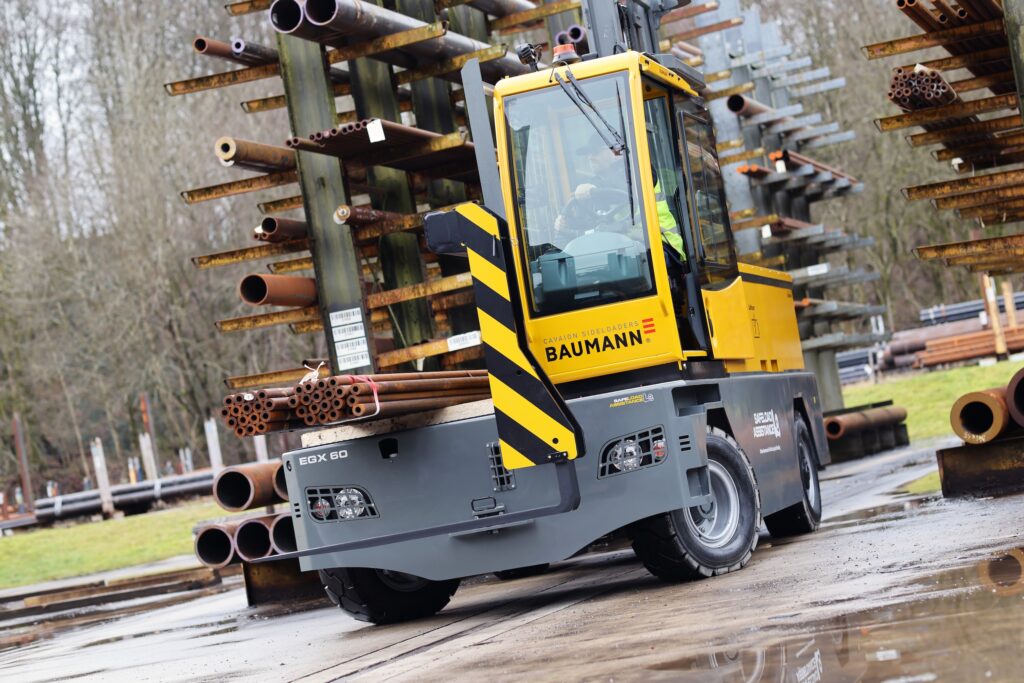
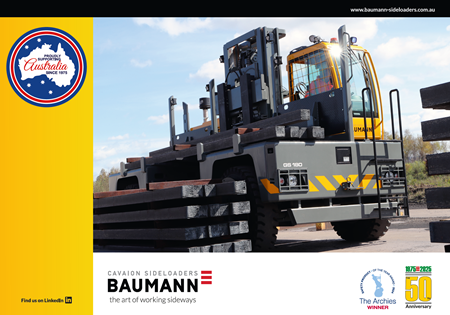
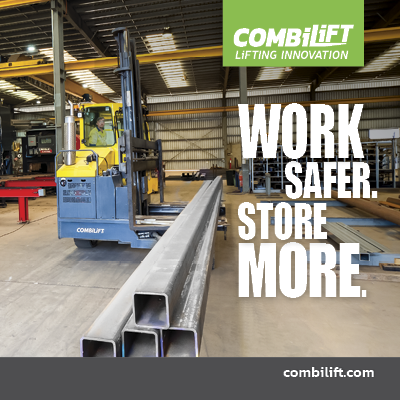
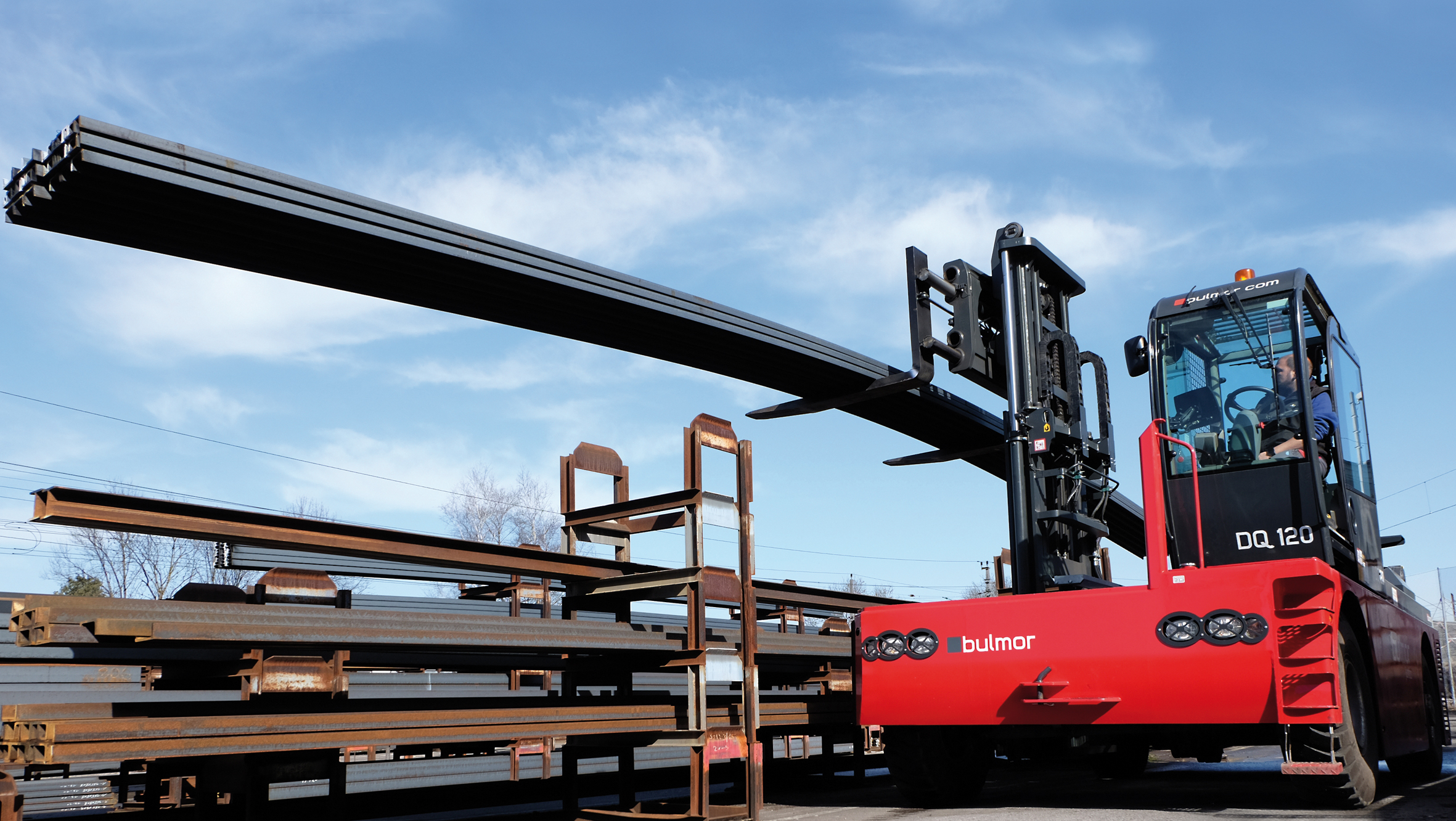
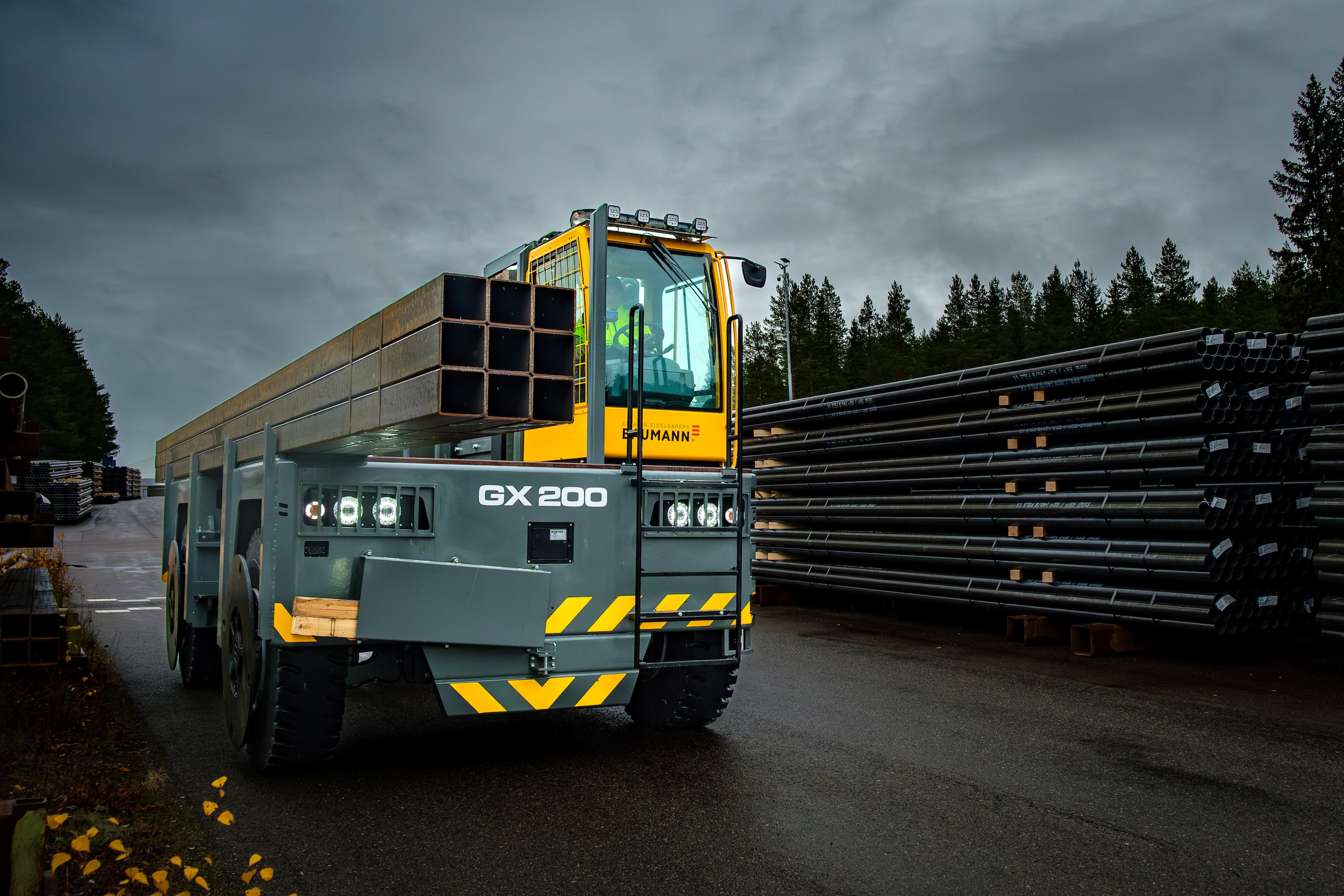
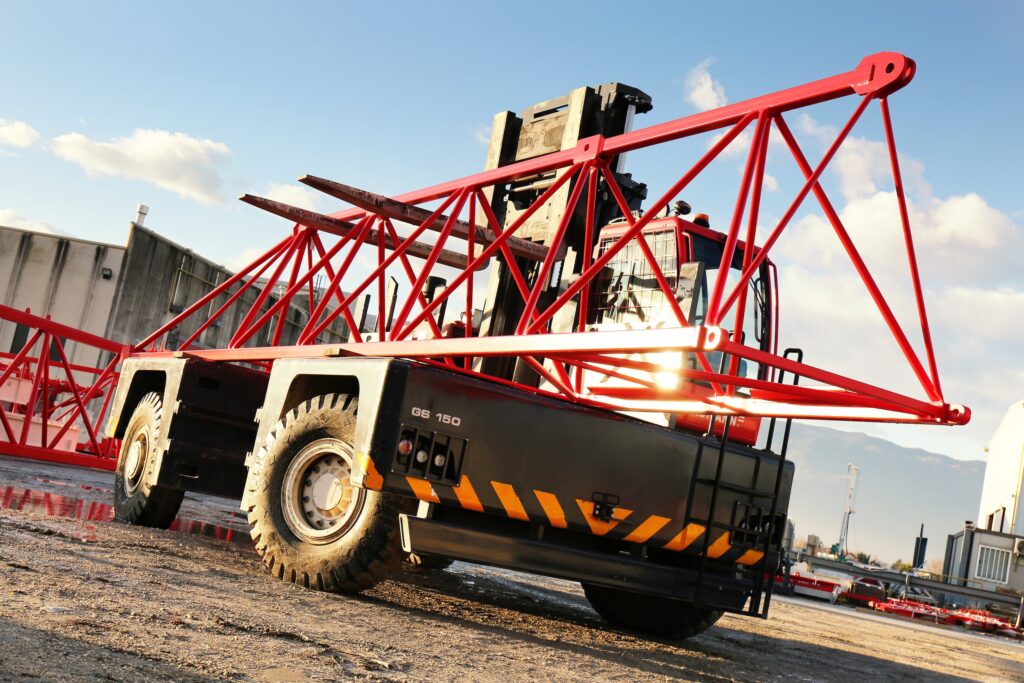
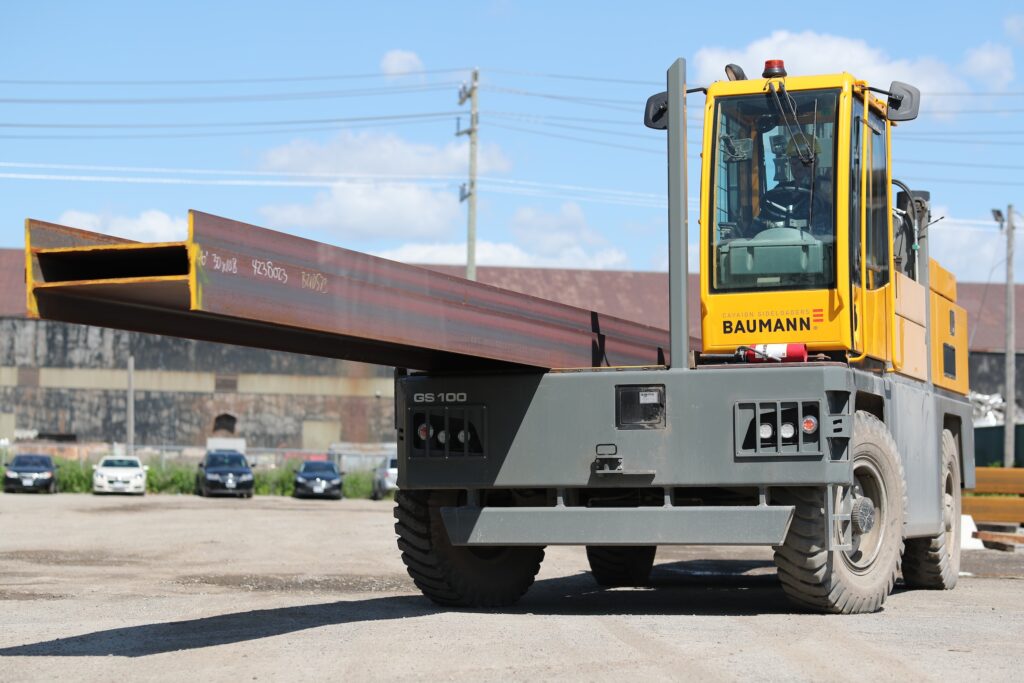
This is where Baumann’s sideloader concept is designed to make a practical difference. Rather than carrying a long load across the front of a machine, a sideloader carries the load laterally, supported along the side of the truck. For steel yards and service centres, that change in orientation can improve stability, visibility and manoeuvrability.
The rule of thirds
Armstrong-Fray often explains the principle through what he calls the ‘rule of thirds’. When handling a 12m length of pipe, the load should ideally be supported across approximately one third of its length.
“That means four metres out the front, four metres supported, and four metres out the back,” he says. “You cannot do that properly with a normal forklift. The rule of thirds is something the industry should adopt as a standard.”
“The issue is not just whether the machine can lift the load. It is whether it can support, control and transport that load in a way that reduces the risk of instability, product damage or operator workarounds.”
Those workarounds are often where risk creeps in. Operators may travel with forks raised to improve clearance or visibility. They may take wider routes to avoid tight spaces. They may rely on spotters, hand signals or experience to compensate for limitations in the equipment. Each step may make sense in the moment, but together they can increase exposure to hazards.
A safety-by-design approach aims to reduce the need for those decisions in the first place. In the hierarchy of controls, equipment choice sits well above administrative controls and personal protective equipment. While training, procedures, line marking and PPE remain essential, they should not be the primary defence against a foreseeable handling risk.
“If the task is moving long steel, then the safest answer is to start with equipment that has been designed for long steel,” Armstrong-Fray says.
Equipment designed for long steel
Visibility is a key example. In a steel yard, line of sight is everything. Operators need to see pedestrians, racking, trucks, doorways, storage locations and other mobile plant. A long load carried across the front of a conventional forklift can compromise that view, particularly in confined spaces. A sideloader, by contrast, is designed to travel with the load positioned alongside the machine, improving the operator’s ability to move through narrow spaces while keeping the load supported.
Load stability is another important consideration. Many businesses focus on weight capacity, but Armstrong-Fray says weight alone does not tell the full story. The position of the load, its centre of gravity and the distance from the machine all matter.
“You can have a load that is under the weight capacity, but over the load centre capacity,” he says. “It is like a seesaw. The further out you put the child, the lighter it is to lift the adult. With an extended load, that load centre becomes critical.”
SafeLoad assistance
Baumann has responded to that risk through its SafeLoad Assistance system. Armstrong-Fray describes it as much more than a weight gauge. The system is designed to measure the forces acting on the machine, taking into account not only the weight being lifted, but also the load centre and the torque being generated.
“SafeLoad Assistance measures torque through sensors on the chassis and mast,” he says. “That is a crucial difference for safety.”
The system uses a traffic-light style display, similar to systems long used in the crane industry. Green indicates the machine is operating within safe parameters. Orange provides a warning. Red indicates that the limits have been exceeded.
For operators, that provides clear, real-time feedback. For managers, it creates another layer of assurance that equipment is being used within its intended operating envelope.
Pedestrian interaction is another major risk in steel-handling environments. Steel yards are dynamic workplaces, with people often working near loading areas, trucks, racking and mobile plant. Armstrong-Fray says technology is increasingly able to support safer separation between pedestrians and machines.
“There are other safety technologies we can use, such as pedestrian detection awareness,” he says. “It uses a combination of cameras and AI to detect pedestrians. There are a lot of technological advancements that increase the safety envelope.”
Importantly, technology is not a replacement for good site design. Pedestrian separation, traffic management plans, exclusion zones, lighting, signage, operator training and supervision all remain critical. But the right equipment and safety systems can reduce reliance on human judgement alone, particularly in high-pressure environments where steel needs to be moved quickly and efficiently.
Carry the load the way it should be carried
Carry the load the way it should be carried
For Baumann, the case for sideloaders is ultimately a practical one. They are not simply an alternative type of forklift; they are purpose-built machines for a specific handling challenge. In steel, where loads are long, heavy, valuable and often awkward, that distinction matters.
“Side loaders allow you to carry the load the way it should be carried,” Armstrong-Fray says. “It is about eliminating the wobble, improving visibility and giving operators the right tool for the job.”
As the steel industry continues to focus on safety, productivity and better risk control, long-load handling deserves close attention. The safest solution is rarely one control in isolation. It is the combination of good yard design, trained people, effective procedures and fit-for-purpose equipment. For businesses handling long steel every day, safety by design starts before the load is lifted.
For further information, visit: https://baumann-sideloaders.com.au/